CONTENTS
-
GENERAL FIRST-AID INFORMATION
-
FIRST AID'S PRIMARY PURPOSES
-
ABC OF THE FIRST AID
-
ASSESSING THE PATIENT/INJURED PERSON AND THE SCENE
-
THE FIRST STAGES TO ASSESS THE PATIENT/INJURED PERSON
-
THE SECOND STAGES TO ASSESS THE PATIENT/INJURED PERSON
-
ASIC LIFE SUPPORT
GENERAL FIRST-AID INFORMATION
WHAT IS FIRST AID?
The applications without medicine which are carried out with the available tools and materials without waiting for the medical tools, at the scene of accident, to save life or to prevent the situation from becoming worse, during an accident or a situation that endangers the life of people, until the health officers arrive and help.
WHO IS THE FIRST AIDER?
The trained person (or people), who carries out the applications on the patient or the injured person, without medicine and by using the available tools without waiting for the medical tools and equipments, according to the purposes stated in the definition of the first-aid.
A GOOD FIRST AIDER...
-
Shall firstly protect his/her own life safety.
-
Shall be aware of the scene.
-
Shall organize and direct the people around, correctly.
-
Shall be calm, self-confident and practical.
-
Shall use whatever he/she has in the best way.
-
Shall have the basic knowledge about the human body and basic functions.
-
Shall use his/her knowledge to make the required interventions on the injured people.
-
Shall avoid applications that may harm the injured people.
WHAT IS THE EMERGENCY TREATMENT?
The medical interventions done by the physicians and health personnel on the patients/injured people at 112 emergency ambulances and emergency treatment units.
THE DIFFERENCE BETWEEN THE FIRST-AID AND THE EMERGENCY TREATMENT
The emergency treatment is the intervention done by the health personnel by using the required equipments, while the first aid is the intervention made by any trained person to save life, by using whatever material is available at the scene.
FIRST AID'S PRIMARY PURPOSES
-
To remove the life-threatening danger.
-
To ensure the vital functions continue.
-
To prevent the situation of the patient/injured person from becoming worse.
-
To make the healing process easier.
THE BASIC APPLICATIONS OF THE FIRST AID?
-
Protection
-
Informing
-
Rescue
PROTECTION : Includes the evaluation of the scene to prevent the accident results from becoming worse. The most important process is to create a safe environment by determining the possible dangers at the scene.
INFORMING : The incident/accident shall be notified to the required institutions via phone or by other people, as quick as possible. The phone communications in Turkey for any situation that requires first-aid is carried out with 112 emergency telephone number.
RESCUE : The intervention must be done on the patient/injured person at the scene in a fast but calm way.
WHAT A FIRST AIDER SHOULD BASICALLY DO
-
Firstly, determine the people to intervene
-
Make people calmer, ease their worries and fears
-
Organize people
-
Use the available possibilities you have
-
Keep the injured person warm
-
Do not allow the injured person to see his/her wound
-
Do not move the injured person
-
Never move the injured person from the current location, unless there is a vital danger
-
Send to the closest health institution in the most suitable way
-
(call 112 emergency service)
-
Patient / injured person name and incident must be defined.
-
Number of patients/injured people and their conditions shall be stated.
-
If any kind of first-aid application is done, the aid type shall be explained
-
The telephone call shall not be ended until the person who listens to you on 112 emergency service line says all the required information is received.
ABC OF THE FIRST AID
The conscious shall be checked, if there is loss of consciousness the belowmentioned points shall be quickly assessed:
A. Assessment of the airway patency.
B. Assessment of the breathing (Look-Listen-Feel)
C. Assessment of the circulation (Breathing, coughing, movement etc. life indicators)

ASSESSING THE PATIENT/INJURED PERSON AND THE SCENE
What are the systems that constitute the body, which must be known by the first aider?
The movement system: Allows the body to move, be supported, and has protective function. Movement system consists of these structures:
The circulation system: Transports the oxygen, nourishment, hormone, immunity elements and similar elements of the body tissues and re-collects them. The circulation system consists of these structures;
Nervous system: It is responsible from the conscious, understanding, thinking, perception, movement harmony, balance, breathing and circulation.
The nervous system consists of these structures:
-
Brain
-
Cerebellum
-
Spinal Cord
-
Spinal Bulb
The urinary system: Filters the blood and protects the internal balance of the body by keeping the required materials within the body and removing the harmful ones.
The urinary system consists of:
-
Urinary tract
-
Urinary bladder
-
Urinary canals
-
Kidneys
The respiratory system: Provides oxygen to the cells and the tissues by carrying out the required gas transfers for the body.
The respiratory system consists of:
-
The respiratory tract,
-
Lungs
The digestive system: Allows the food taken from the mouth to be digested and be distributed to the body via the blood circulation.
The digestive system consists of:
-
Tongue and teeth
-
Esophagus
-
Stomach
-
Gall bladder
-
Pancreas
THE PURPOSES IN ASSESSING THE PATIENT'S/INJURED PERSON'S CONDITION
-
To determine the severity of the disease or the injury
-
To determine the first aid priorities
-
To determine the first-aid type
-
To provide a safe intervention
THE FIRST STAGES TO ASSESS THE PATIENT/INJURED PERSON
The patient's/injured person's consciousness is assessed by asking "do you feel well?" by slightly touching the shoulders or just verbally. Assessing the consciousness is important for the following stages. Depending on this, the first assessment stages are as below:
ASSESSING THE AIRWAY PATENCY
-
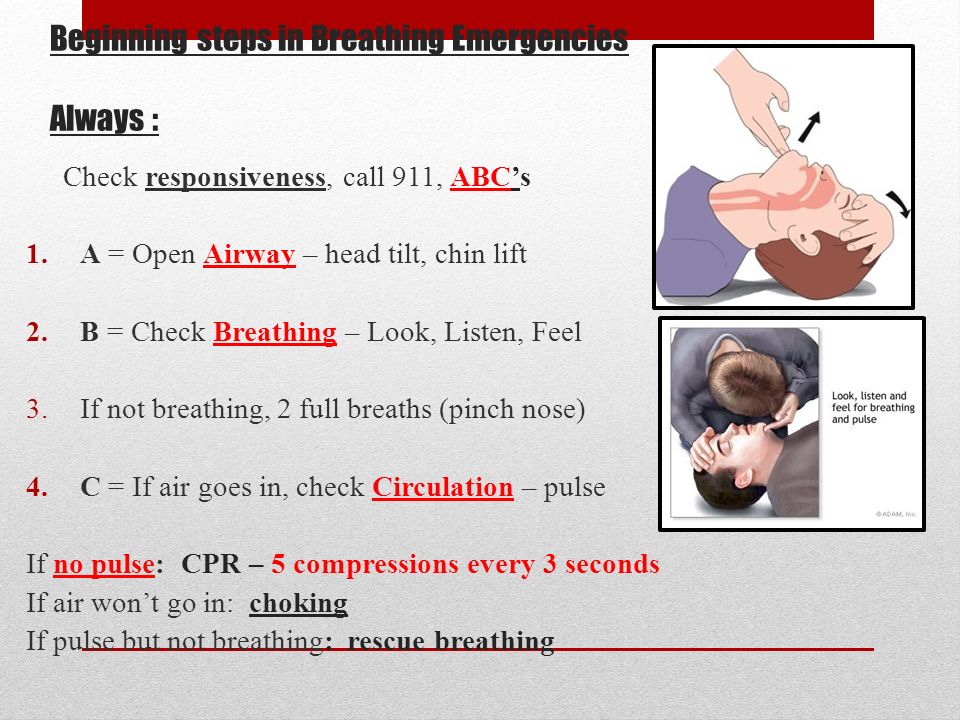
The tongue may block the airway especially in scope of the people who lose their consciousness or because of vomited matter or foreign bodies. The airway shall be open to ensure the air reaches the lungs.
-
While making the airway open, the patient/injured person shall be laid down in such a way the head, neck and body form a flat axis
-
If there is loss of consciousness, the inside of the mouth shall be checked, if there is any material it shall be removed with the help of a fabric.
-
Then the Head-Jaw position is provided by putting one hand on the forehead of the patient/injured person, and by holding the jaw with the 2-3 fingers of the other hand, and pushing the head backwards. Rough actions shall be avoided during these processes.
B. ASSESSING THE BREATHING
-
The first aider turns his/her head to the side, brings his/her face closer to the mouth of the patient/injured person
-
Assesses whether the person breathes or not for 10 seconds by using the Look-Listen-Feel method.
The breathing movements are observed. The breathing sound is listened to. Tries to feel the breathe of the patient/injured person on his/her cheek. If there is no breathing, begins to apply artificial respiration immediately.
C. ASSESSING THE CIRCULATION
If there is any vital indicator (coughing, movement of hands, legs, etc.) never apply the heart massage
-
As the result of the first assessment, if the patient/injured person has no consciousness but has breathing, movement etc. vital indicators, then the person shall be put to the coma position and other injured people should be assessed.
THE SECOND ASSESSMENT OF THE PATIENT/INJURED PERSON
After the patient's/injured person's vital indicators' existence is ensured with the first examination, the first aider switches to the second examination stage and carries out examination thoroughly. These are the second assessment stages:
Receiving information by talking:
-
Self-introduction,
-
The name of the patient/injured person shall be learned and used to address the person,
-
Gives confidence by behaving gently and tolerant,
-
Gives comfort by easing the worries of the patient/injured person,
-
Learns the incident's nature, conditions, personal histories, what was eaten last, used medications and existence of allergies by asking questions.
Through examination is carried out:
-
Consciousness level, understanding, perception
-
Breathing times, rhythm, depth
-
Body or skin heat, humidity, color
Head: It is assessed if there is any injury, purpleness on the hair, scalp, head and face; if blood or liquid comes from the nose or the ear; inside of the mouth is checked.
Neck: Pain, sensitivity, swelling, deformation existence is examined. The neck damage possibility shall not be ignored unless proven otherwise.
Chest cage: It shall be assessed if there is stuck item, open injury, deformation or purpleness, whether pain is felt under slight pressure, or bleeding. It is examined if the chest cage expansion is normal or not. During the chest examination the hands are moved backwards and the back of the patient/injured person must be controlled.
Abdominal cavity: It shall be assessed if there is stuck item, open injury, deformation, swelling, purpleness, pain or sensitivity in addition to the softness of the abdomen. The examination is made by moving the hands towards the waist, then the same examination is carried out for the thigh bones to look for injuries or broken bones.
Limbs: Lack of feeling or strength, pain, swelling, deformation, function loss and bone breakage possibilities are assessed.
The intervention method for the current situation is selected after the second assessment.
THE PURPOSE OF ASSESSING THE SCENE
-
To ensure no accident happens on the scene again,
-
To determine the number and type of the patients/injured people at the area.
-
After the scene is quickly assessed, the interventions to be carried out are planned.
THE THINGS TO DO WHILE ASSESSING THE INCIDENT AREA
-
The belowmentioned points must absolutely be carried out while assessing any incident area:
-
If possible the vehicle that involved in the accident should be taken to a secure area outside the road, engine be shut off, parking brake be pulled, if the vehicle uses LPG, the valve of the tube at the trunk must be turned off.
-
The incident area shall be marked in a sufficiently visible way. Warning signs should be placed to prevent a possible accident and to slower the vehicle drivers that may arrive at the accident's location from behind or front side. Warning triangles shall be used for this.
-
The curious people at the scene who may prevent or make it harder to help the patient/injured person shall be kept away from the scene
-
No one must smoke, to prevent a possible explosion or fire risk.
-
If there is a gas existence risk, required precautions shall be taken to prevent poisoning.
-
Environment shall be ventilated
-
The illumination or calling tools that may cause sparks shall not be allowed to be used.
-
The patient/injured person shall not be moved from current location.
-
The patient/injured person shall quickly be assessed in terms of vital indicators (ABC).
-
The patient/injured person shall be assessed in terms of breakage and bleeding.
-
The patient/injured person shall be kept warm.
-
The patient/injured person shall not be given anything via his/her mouth.
-
Medical aid shall be requested (112).
BASIC LIFE SUPPORT
What is respiratory standstill and heart arrest?
Respiratory standstill: The state when the body is deprived of the oxygen it needs to live, because the respiratory movements are stopped. If artificial respiration is not started immediately, heart arrest will occur after a while
Heart arrest: When the person with the loss of conscious does not show vital indicators such as breathing, coughing, movement, etc. If no intervention is made within 5 minutes, the tissue oxygenation will be corrupted and brain damage will occur.
WHAT IS THE BASIC LIFE SUPPORT?
After the airway patency is ensured to save the life, the interventions made on the person whose respiration and/or heart stopped, without medication to ensure oxygen is delivered to the lungs by making artificial respiration and to ensure the blood is pumped from the heart by making outer heart massage. When the basic life support is begun, if there is anyone around that person shall call 112. If the rescuer is alone, 112 shall be called immediately after the assessment of the consciousness of the adult.
In these cases 112 shall be called after applying 5 tours (approximately 2 minutes) of Basic Life Support :
-
Drowning cases
-
Trauma cases
-
Children and babies
-
Freezing cases
HOW TO ENSURE THE HEAD-JAW POSITION TO OPEN THE AIRWAY?
The airway of all patients/injured people who lost consciousness shall be checked. Because the tongue may slide backwards or any foreign material may block the airway. The inside of the mouth is controlled and cleaned, then the head-jaw position is given to the patient.
To do this:
One hand is put on the forehead,
Two fingers of the other hand are put on the jaw,
The head is tilted backwards.
Therefore the tongue is moved from its place and the airway patency is provided.
HOW TO CARRY OUT THE ARTIFICIAL RESPIRATION?
After the airway patency of the patient/injured people is ensured, Look-Listen-Feel method is used to make assessment, if there is no respiration, the medical aid is requested (112), and immediately the artificial respiration is begun.
YOU SHOULD ABSOLUTELY BE SURE THAT THERE IS NO RESPIRATION, BEFORE BEGINNING THE ARTIFICIAL RESPIRATION!
HOW TO GIVE THE HEAD-JAW POSITION TO THE PATIENT/INJURED PERSON FOR MOUTH-MOUTH METHOD:
-
The nose wings are closed to prevent air passage by using one hand's thumb and index finger.
-
The first aider, grasps the mouth of the patient/injured person with his/her mouth to prevent air passage,
-
The air is blown two times through the mouth so that 400- 500 ml of air is delivered to the patient's lungs. Each of the rescue breathes shall last for 1 second, the chest expansion shall be observed with eyes.
-
The air provided in this way has enough oxygen (16-18%) to protect the vital organs.
-
The artificial respiration shall be applied by giving air from mouth to the nose, for babies and for adults when their jaws are locked.
-
The first aider can use thin cheesecloth, gauze etc. to protect himself/herself during the artificial respiration.
-
If there is no vital indicator (breathing, coughing, movement etc.) immediately after the rescue breathes, the heart massage is begun.
HOW TO CARRY OUT THE OUTER HEART MASSAGE?
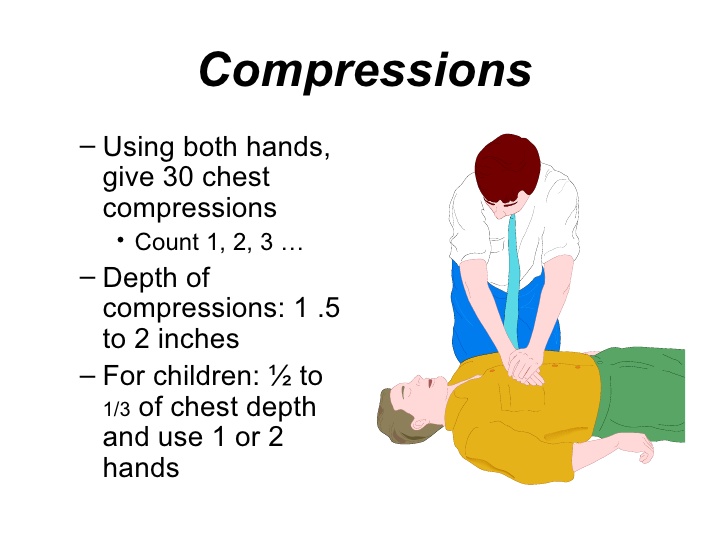
If there is no circulation indicator after the artificial respiration, the outer heart massage is begun.
YOU MUST BE ABSOLUTELY SURE THAT THE HEART COMPLETELY STOPPED, BEFORE STARTING THE HEART MASSAGE!
-
If there is anyone around, that person shall call 112 immediately while the basic life support is begun. For children and babies, adult drowning and traumas, if the first aider is alone, the aider shall call for help after applying 5 tours of basic life support (approximately 2 minutes).
-
The heart massage location is exactly the middle point of the chestbone. This can be found as the intersection point of the imaginary line passing through the nipples and the chestbone.
-
Both hands' fingers are intertwined in the middle of the chestbone and attention is paid to prevent contact with the patient. The hands must be held fixed. The elbows and shoulders should stand straight, perpendicular to the body of the patient/injured person.
-
The pressure is applied as rhythmicsqueezing-relaxation by using the body weight, in such a way the ribs collapse inside 4-5 cm (when looked from the sides, 1/3 of the breast height) 100 pressures per minute should be applied for adults
-
After each 5 tours (one tour consists of 30 heart massages - 2 respiration) the patient's vital indicators are quickly assessed.
(*) Age is an important factor to consider during the basic life support. One of the main reasons for the death of the patients with middle age and above is, the heart conditions. In such a situation, when 112 team that arrives at the scene uses defibrillation, the chance to save the patient can be increased. This is why calling 112 quickly is extremely important.
WHAT IS AIRWAY OBSTRUCTION?
It happens when the airway is obstructed in such a way the passage of the air required for respiration is prevented. It can happen as full or partial obstruction.
WHAT ARE THE INDICATIONS OF THE AIRWAY OBSTRUCTION?
Full obstruction indicators:
-
The person cannot breathe,
-
Feels pain, brings hands to the neck,
-
Can't talk,
-
The person's color becomes purple.
Heimlich Maneuver (pressure application on the abdomen) is applied in such a case. .
Partial obstruction indicators:
-
The person coughs,
-
can breathe,
-
can talk.
In such a case the patient is not intervened, but encouraged to cough.
Heimlich Maneuver For People Who Are Still Conscious:
-
The patient can sit or be in standing position,
-
The back of the patient is hit 5 times. If there is no success;
-
The person's body is held by hugging from behind,
-
The thumb of one hand is placed on top section of the stomach, below the chestbone, as a fist. The other hand grabs the fist hand
-
Pressure is applied backwards and upwards, strongly.
-
This is repeated by hitting on the back 5 times, consecutively, until the foreign material is out.
-
Medical aid is requested (112).
Heimlich Maneuver for people who lost their consciousness:
When there is airway obstruction suspicion in such cases, the first aiders are going to apply the Basic Life Support applications. If the rescuer gives breath but the air is not delivered it is thought there is obstruction, the first aider shall check whether there is a foreign material within the mouth, and it shall be removed if visible. If not visible, basic life support applications shall begun.
How to apply first aid on people with partial obstruction?
-
If sufficient air passage is available in scope of the airway of the person, the person shall be encouraged to cough, observed closely and no other intervention shall be made. Position should be taken behind the accident victim during this period where the person can still stand.
-
In this situation, the victim should firstly be left in the position the person was found.
-
If the victim's breathing and coughing become weaker or lost and if purpleness is observed, intervention shall be made immediately.
-
If there is a visible foreign material, displaced or loose artificial teeth etc. they are removed.
-
If a foreign material cannot be observed and if the patient's situation is becoming worse, the applications explained above for the full obstruction shall be applied.
FIRST AID FOR BLEEDING CASES
What is bleeding?
It is the situation when the blood pours outside the vessel as the vessel integrity is damaged (towards the inside or outside of the body). The severity of the bleeding depends on:
HOW MANY TYPES OF BLEEDING ARE THERE?
There are 3 types of bleeding according to the location where the blood is poured:
External bleeding: The bleeding is from the injury, towards the outside of the body
Internal bleeding: Not visible as the bleeding is towards the inside of the body.
Bleeding from the natural orifices: Ear, nose, mouth.
Bleeding Types Based On Vessels:
Arterial bleeding : Arterial bleeding has light color and pours interruptedly in harmony with the heart beats.
Vena bleeding : Dark colored, as leakages.
Capillary vessel bleeding : Capillary vessel bleeding occurs as small bubbles. Stops easily.
WHAT ARE THE FIRST AID APPLICATIONS FOR BLEEDING CASES?
First aid for outer bleeding:
-
Condition of the patient/injured person is assessed (ABC),
-
Medical aid is requested (112
-
Injury or bleeding is assessed,
-
Pressure is applied on the bleeding place with clean fabric,
-
A second fabric is placed, if the bleeding does not stop, to increase the pressure,
-
The pressure is applied by putting bandage if required,
-
Pressure is applied on the pressure point closest to the bleeding location,
-
The bleeding location is lifted upwards,
-
If there is only one first aider in an environment with multiple injured people, if the injured person is going to be moved to a location under difficult conditions, if it is not enough to put pressure on the pressure points and/or if a limb is severed, tourniquet is applied.
-
Shock position is given,
-
Vital indicators are assessed frequently (once in 2-3 minutes)
-
The patient/injured person is covered in such a way the bleeding area is kept outside,
-
The information regarding the applications (tourniquet, etc.) is written on the patient/injured person,
-
The person is transferred quickly.
BODY POINTS TO APPLY PRESSURE
In artery bleedings, the blood gushes with pressure. Therefore too much blood is lost in a short time. What must be done for such bleedings is to apply pressure on the bleeding point or on the upper artery area closest to the bleeding point. These are the pressure points of the body determined for this purpose:
1-Neck : Neck artery (carotid artery) pressure point
2-On collarbone : Arm artery pressure point
3-Armpit : Arm artery pressure point
4-Top section of the arm : Arm artery pressure point
5-Groin : Leg artery pressure point
6-Femur : Leg artery pressure point
TRIANGULAR BANDAGE APPLICATION FOR BLEEDINGS
The triangular bandage can be used as bandage and/or hanger at various body sections. The top section of the triangular bandage is brought to its base and placed, then folded on it once or twice and a bandage is obtained at the desired width.
The hand is placed on the triangular bandage in such a way the fingers be placed at the top of the triangle. The top of the triangle is folded towards the wrist. At the back of the hand, the triangle's points face themselves and crossed, it is tied at the wrist level.
The foot is placed on the triangle straight, in such a way the fingers face the top of the triangle. It is brought forwards in such a way to cross the top of the triangular bandage on the foot. Both ends are tied around the ankle.
The base of the triangle is placed 3-4 fingers below the knee, in such a way the end is located on the knee. The points are crossed behind the knee, the points are tied above the knee.
The top of the triangle is placed on the shoulder and tied at the back in such a way the base covers the chest. This knot and the top of the triangle are tied with each other by using another fabric.
The triangle's base is tied around the bottom section of the femur, the top is tied to a fabric or belt that covers around the waist.
FIRST AID FOR BLEEDING FROM THE NATURAL ORIFICES
Nose bleeding:
-
The patient/injured person is calmed down, his/her worries are eased.
-
It is ensured the person sits,
-
The person's head is slightly tilted forwards,
-
Nose wings are squeezedfor 5 minutes.
-
The person is ensured to visit an expert physician
Ear bleeding:
-
The patient/injured person is calmed down, his/her worries are eased.
-
If the bleeding is slight, the ear is cleaned with a clean fabric,
-
If the bleeding is serious, it is closed with clean fabrics without blocking the ear,
-
If the person still has consciousness, he/she lies on his/her back without moving; if the consciousness is lost, the person is laid on side, on the bleeding ear.
The patient/injured person is sent to an expert physician with the blood samples in cases of bleeding from the ear, anus, reproductive organs or in case of vomiting blood.
FIRST AID DURING INJURIES
What is a wound?
It is the deterioration of the skin or mucosa integrity as the result of a trauma. Also the blood vessels, muscles and structures such as nerves etc. may be affected. Infection risk increases as the skin's protective property is damaged.
How many wound types are there?
Cut wounds:
Happens as the result of sharp tools such as knife, pocket knife, glass, etc. They are generally simple wounds. Their depths are easily determined.
Crush wounds:
They occur as the result of severe impact of stones, fists, clubs, etc. Wound edges are crushed. There is not much bleeding, but sensitivity and tissue damage.
Puncture wounds:
They occur as the result of long and sharp tools. Depth is dominant on the surface. It can be deceptive, bears tetanus risk.
Fragmental wounds:
It occurs as the result of drawing effect on the tissues. All tissue related organs and scalp can be damaged.
Infected wounds:
Wounds with infection possibility. The wounds with high infection risk are:
-
Delayed wounds (more than 6 hours),
-
Wounds, of which stitches are separated,
-
Wounds with irregular edges,
-
Very dirty and deep wounds
-
Firearm wounds,
-
Wounds as the result of biting and stinging.
What are the common indicators of the wounds?
First aid process for the injuries
- Occurrence type
- Duration
- Foreign material existence
- Bleeding etc.
-
Bleeding is stopped
-
It is covered,
-
The person is ensured to visit a health institution,
-
Tetanus warning is made,
-
The foreign materials on the wound shall not be touched!
WHAT ARE THE SERIOUS INJURIES?
-
Wounds, of which bleeding cannot be stopped,
-
Wounds where the muscle or bone is visible,
-
Wounds caused by piercing materials,
-
Wounds where foreign materials are stuck,
-
Human or animal bites,
-
Wounds which seem to have a possibility of leaving a mark.
How to apply the first aid:
-
The foreign materials stuck on the wound are not removed,
-
If the wound bleeds, bleeding is stopped,
-
The inside of the wound shall not be tampered with,
-
The wound is covered with clean fabric (a humid fabric),
FIRST AID IN CASES OF SKULL - SPINE INJURIES
-
Consciousness of the person is checked,
-
Life indicators are assessed,
-
Immediately the medical aid is requested (112).
-
If the person is conscious, it is ensured the person does not move
-
If there is any danger, the person is moved in straight position,
-
The head-neck-body axis must be preserved,
-
When the help arrives, the person shall be placed on the stretcher by preserving the head-neck-body axis.
-
The person shall not be exposed to shaking movements during the transportation and delivery,
-
All carried out processes and the information on the patient/injured person shall be recorded and notified to the arriving personnel.
-
The person shall never be left alone.
Indicators:
-
Changes in the consciousness level, memory changes or memory loss
-
Pain in the head, neck or back
-
Pins and needles or loss of feeling at the fingers and hands
-
Full or partial movement loss at any body part
-
Deformation of head or backbone
-
Brain spinal fluid and blood coming from the ear and nose
-
Outer bleeding on head, neck and back
-
Concussion
-
Balance loss
-
Purpleness around the eyes and ears
But, even if the patient shows no indicator,
-
Face and collarbone injuries,
-
All cases of falling,
-
Traffic accidents
-
All patients/injured people who lost their consciousness shall be deemed as head and spinal injury.
FIRST AID FOR BURNS - HEAT STROKES
Burn : Tissue deterioration as the result of being exposed to any heat. Burns generally occur as the result of contacting with hot water or vapor and also be caused by contacting with hot solid materials, acid/alkali etc. chemical materials, electric current or radiation.
How many burn types are there?
Physical burns::
-
Heat burns
-
Electric burns
-
Beam burns
-
Friction burns
-
Freeze burns
Chemical burns:
Which factors determine the severity of a burn?
HOW TO GRADE THE BURNS
1. degree burns: Skin redness, pain, oedema at the burn area. Heals in 48 hours approximately.
2. degree burns: Skin has blisters with water inside (bulla). Painful.Heals on its own when the skin renews itself.
3. degree burns: All layers of the skin are affected. Its effects are visible especially on muscles, nerves and vessels. It has degrees from white and dark wounds to black color. No pain, as the nerves are damaged.
Negative effects of the burns on the body; The burns cause functional disorders of the organs and systems depending on depth, extensiveness and the area. Shock occurs based on the pain and liquid loss. Infection occurs because of the microbes and toxins in the body of the patient/injured person.
FIRST AID PROCEDURES FOR HEAT BURNS
-
If the person is still burning, the panic and running is prevented,
-
Blanket or cover is used to cover the patient/injured person and it is ensured the person is rolled,
-
Life indicators are assessed (ABC),
-
It is checked if the breathing passage is affected or not,
-
The burnt area is kept under cold water for at least 20 minutes (if the burn surface is large, it is not recommended as it will cause temperature loss),
-
Ring, bracelet, watch etc. items are removed in case oedema may occur.
-
The clothes are removed without lifting the skin at the burn area,
-
If there are stuck parts they are cut, attention is paid to the hygiene and cleaning.
-
The places that collected water shall not be popped,
-
Medication or burn ointment shall not be spread on the burn,
-
The burn is covered with clean fabric,
-
The patient/injured person is covered with blanket.
-
The burnt areas shall not be bandaged together,
-
If the burn is extensive and medical institution is far, if the patient/injured person does not vomit and still has consciousness, liquid loss is prevented by giving liquid from mouth,
-
Medical aid is requested (112).
FIRST AID PROCEDURES FOR THE CHEMICAL BURNS
-
The contact of the chemical material that contacted the skin shall be stopped as soon as possible,
-
The area shall be washed for at least 15-20 minutes, softly, with plenty of water without pressure,
-
Clothes shall be removed,
-
Patient/injured person shall be covered,
-
Medical aid shall be requested (112).
FIRST AID PROCEDURES FOR THE ELECTRIC BURNS
-
Being calm is important,
-
The electric current shall be stopped before touching the patient/injured person, if it is not possible, a wood stick or rope etc. item shall be used to stop the electric contact.
-
ABC of patient/injured person is assessed,
-
Absolutely no intervention must be made to the patient/injured person with water
-
The patient/injured person shall not be moved,
-
The damaged area shall be covered with clean fabric
-
Medical aid shall be requested (112).
INDICATIONS OF THE HEAT STROKE
Some disorders occur when the body cannot adjust its temperature as the result of high temperature and humidity level. These are the indications of the heat stroke:
-
Muscle cramps,
-
Tiredness, fatigue
-
Dizziness
-
Short temper, behavioral disorder
-
Pale and hot skin
-
Plenty of sweat (then reduces)
-
Stomach cramps, vomiting, nausea
-
Loss of consciousness, hallucination
-
Quick pulse
First aid for heat strokes:
-
The patient is taken to a cool and airy place,
-
Clothes are removed,
-
Patient is laid on his/her back, legs and arms are raised,
-
If the person has no nausea and has consciousness, liquid or soda is given to meet water and salt losses.
FIRST AID IN CASES OF FRACTURE, DISLOCATION AND SPRAIN
What is a fracture?
The fracture is the damaging of the bone integrity. The fractures may occur on their own or as the result of impacts. The old age increases the risk of fracture occurrence on its own.
How many fracture types are there?
-
Closed fracture: The bone integrity is damaged. But the skin is strong
-
Open fracture: The skin integrity is damaged. Bone ends may stand outside. They bring along the dangers of bleeding and infection.
What are the possible fracture indications?
NEGATIVE RESULTS OF FRACTURES
-
Injury and squeezing of vessels, nerves, muscles near the fracture. (Paleness, coldness, not being able to feel the pulse at the fracture area)
-
Shock depending on bleeding in segmental fractures
First aid process for the fractures
-
The priority is given to injuries that endanger life,
-
The patient/injured person is kept warm, and is not moved
-
If the arm is affected; watch, ring, etc. items are removed (otherwise a possible oedema will cause tissue damage)
-
When fixation and bandage is applied, the fingers are kept outside in such a way they are seen. So that the finger colors, movements and sensitivity can be controlled),
-
The area with fracture suspicion is fixated by avoiding sudden actions and in such a way to include immediate lower and higher joints. The fixation materials shall be made of hard materials such as club, wood, cardboard etc. and be long enough to contain the lower and higher joints of the broken bone,
-
In open fractures, the wound shall be covered with clean fabric before the fixation,
-
The skin color and heat is controlled frequently at the fracture area,
-
Arms and legs are kept high,
-
Medical aid is requested (112
SPRAINS
It is the momentarily separation of the joint surfaces. It happens as the result of forcing.
What are the sprain indications?
-
Pain at the sprain area
-
Redness, swelling
-
Function loss
First aid process for the sprains
-
The sprained joint is fixed by using a compressing bandage,
-
The area is raised upwards to reduce the swelling,
-
No movement is made,
-
Medical aid is requested (112).
DISLOCATION
It is the permanent separation of the joint surfaces. It cannot return to its normal position on its own.
What are the dislocation's indications?
-
Dense pain
-
Swelling and redness
-
Function loss
First aid process for the dislocation cases
-
The joint is fixated the way it was found,
-
No effort is made to place the dislocated part to its location,
-
The patient/injured person shall not be given anything via his/her mouth.
FIXATION OF THE FRACTURES, SPRAINS AND DISLOCATIONS
The first aider uses the available materials for fixation. These can be triangular bandage, roll bandage, blanket, cardigan, scarf, tie etc. wood, cardboard etc. materials.
-
The injury area must be kept fixed during the fixation process.
-
If there is a wound, it must be covered with clean fabric.
-
The area to be fixated must firstly be covered with soft material,
-
The injured area shall be fixated the way it was found, no correction shall be tried
FIRST AID FOR LOSS OF CONSCIOUSSNESS
Impaired consciousness/loss of consciousness : The partial or complete loss of the consciousness that ranges from the state of sleep because of a disruption in normal brain activities (=impaired consciousness) to not responding to anything (=loss of consciousness ).
Fainting (Syncope): Short term, superficial, temporary loss of consciousness. It is caused by reduced blood flow to the brain.
Coma: Long term loss of consciousness that occurs when the reflexes such as coughing and swallowing and the responses to external stimulus are reduced or non-existent.
BReasons of fainting:
Coma reasons:
-
Falling or severe impacts
-
Especially head traumas
-
Poisoning
-
Extreme alcohol, drug usage
-
Diabetes
-
Liver diseases
-
Convulsion etc. inflammatory diseases
Fainting (syncope) indications:
-
Dizziness, senselessness, falling on the ground
-
Numbness of the legs
-
Mental fog
-
Paleness on the face, shaking, feeling cold
-
Fast and weak pulse
Coma indications:
-
Loss of responses such as coughing, swallowing
-
No response to painful and audible stimulation
-
Stool and urinary incontinence
How the first aid is carried out in such situations;
If the person feels dizziness feeling is coming;
-
The person is laid on his/her back, feet are raised 30 cm
-
Very tight clothes are loosened,
-
The person rests until feeling well
If the person fainted:;
-
The person is laid on his/her back, feet are raised 30 cm.
-
Airway patency is checked and maintained,
-
Very tight clothes are loosened,
-
If vomiting is observed, lateral position is ensured,,
-
Respiration is checked,
-
Curious people around are sent away.
If the consciousness is gone:
-
Vital indications of the patient/injured person is assessed (ABC),
-
Coma position is provided for the patient/injured person
-
Help is called for (112),
-
Respiration and vital conditions are frequently checked,
-
The person is not left alone until help arrives
REASONS OF LOW GLUCOSE
-
Related to diabetes treatment
-
After long exercises
-
Staying hungry for a long time
-
After having meal, in scope of people who had intestinal operations
What are observed when the blood glucose is reduced suddenly?
-
Fear
-
Sweating
-
Quick pulse
-
Shaking
-
Sudden hungriness
-
Tiredness
-
Nausea
What indications are observed if the low blood glucose occurs slowly, in the long term?
-
Headache
-
Visual impairment
-
Numbness
-
Weakness
How to apply the first aid:
-
Patient's ABCis assessed,
-
If the patient has consciousness and is not vomiting, candy, sugary drinks are given from the mouth, excess sugar is not harmful (Even if the indications are caused because of excess sugar, giving extra sugar is less harmful for the patient then staying at the low blood glucose level. Because low blood glucose may cause permanent damage on the brain and other vital organs.),
-
If the indications are still observed after 15-20 minutes, help is called for to deliver to health institution.
-
If the patient is not conscious, coma position is provided and medical help is called for (112).
FIRST AID FOR POISONING CASES
What is poisoning? It is the deterioration of normal functions when a toxic/poisonous material enters the body. Some foreign materials entering the body may harm the vital functions therefore they are accepted as poisonous (toxic).
What are the general indications of poisoning cases?
Digestive system disorders: Nausea, vomiting, stomachache, diarrhea
Nervous system disorders: Loss of consciousness, discomfort feeling, disharmony of movements
Respiratory system disorders: Difficulty in breathing, purpleness, stopped respiration
Circulation system disorders: Pulse disorder, heart arrest
There are three groups of poisoning ways..
By digestion: The most common poisoning way. The poisons taken by digestion are generally the chemicals found at homes or gardens, poisonous mushrooms, expired food, medications and excessive use of alcohol.
By respiration: It is caused when the poisonous material is inhaled. Generally because of materials such as carbon monoxide (gas tube leakages, water heaters, butane gas stoves), carbon dioxide that accumulates at the cesspools or rocks, chlorine used for pool hygiene, adhesives, paints, house cleaners, etc.
By skin: The poisonous material directly enters the body via skin. Such poisoning cases occur because of the insect bites, animal bites, medical injections, hair dyes, agricultural pesticides etc. when harmful materials are absorbed by the body.
First aid for poisoning cases caused by digestion:
-
Consciousness of the person is checked
-
If the mouth contacted with the poisonous material it is rinsed with water, if the material contacted the hands, the hands are washed with soapy water,
-
Life indicators are assessed,
-
Vomiting, nausea, diarrhea etc. indications are assessed,
-
The person is not forced to vomit, especially when the caustic materials are taken, the patient should not vomit,
-
Coma position is given if there is loss of consciousness
-What is the type of the poisonous material
-Does the person use medications or drugs?
-What was the time when the patient was found
-What kind of medications are there at the house?
First aid for poisoning cases caused by respiration:
-
The patient is brought to clear air or the door and windows are opened to aerate the environment,
-
Life indicators are assessed (ABC),
-
The person is kept at semi-sitting position,
-
Coma position is given if there is loss of consciousness
-
Medical aid is requested (112),
-
The first aider takes the required precautions to protect himself/herself and the environment during the intervention
-
Mask or wet fabric is used to protect the respiration,
-
Electric buttons and other electrical tools and illumination devices are not used,
-
If there is dense smoke, rope shall be used to bring the patient outside,
-
The fire brigade shall be informed immediately (110)
FIRST AID WHEN A FOREIGN MATERIAL ENTERS EYE, EAR OR NOSE
What kind of first aid must be applied when a foreign material enters the eye?
If it is a small material such as dust;
-
The eye is directed to the light and the inside of the bottom eye lid is observed
-
If required the upper eye lid is kept open,
-
It is tried to be brought outside with a humid, clean fabric,
-
The patient is told to blink,
-
.the eye shall not be rubbed,
-
If it cannot be taken outside, the person is sent to a health institution,
If an object is stuck or metal object is inside:
-
Do not move the patient unless necessary,
-
Do not touch the eye in any way,
-
Medical aid is requested (112).
-
The patient is sent to a medical institution expert in eye care.
What kind of first aid must be applied when a foreign material enters the ear?
-
Absolutely do not intervene with a sharp or piercing object,
-
Do not let water contact with
-
Medical aid is requested (112).
What kind of first aid must be applied when a foreign material enters the nose?
-
Nose wall is pressured and a strong breath is given to eject the object,
-
If it does not exit, medical aid is requested (112)
FIRST AID IN SUFFOCATION CASES
Suffocation : Suffocation is the occurrence of deterioration when the body tissues do not receive enough oxygen.
What are the reasons of suffocation?
-
When the tongue is slid backwards as the result of fainting or loss of consciousness
-
When liquid fills the windpipe
-
When a foreign material gets into the windpipe
-
Hanging
-
Lung damage
-
Gas poisoning
-
Drowning in water (*)
-
(*) In drowning cases, very little amount of water enters the lungs depending on the contraction of the windpipe entrance during the drowning. The artificial respiration and heart massage shall be started for those who drown in water, even if 20-30 minutes passed, especially in cold weathers.
-
In cases of drowning in water, the mouth to mouth or mouth to nose respiration can be done in water and this application shall be started when in water. It may not be possible in deep waters, therefore the patient/injured person must be quickly pulled to shallow waters.
-
The general body trauma or spinal fracture possibility shall be thought about in addition to the drowning risk as the result of jumping into the water. Therefore in the water, the head must not be pulled backwards too much.
What are the general indications of drowning cases?
-
Breathing difficulties
-
Noisy, fast and deep breathing
-
Foaming and phlegm accumulation at the mouth
-
Purpleness on face, lips and nails
-
General discomfort state, inconsistency and indecisiveness in responding
-
Fainting
How to apply first aid for drowning cases?
-
The reason that causes drowning is solved,
-
Consciousness of the person is checked,
-
Life indicators are assessed (ABC),
-
Basic life support is given,
-
Immediately the medical aid is requested (112),
-
Vital indicators are observed.
|


