|
CONTENTS
THEORY OF FIRE Fire has been used for thousands of years and is one of the basic elements required for our lives. Despite of its benefits, it has been a power with both positive and negative effects during the history. Fire has become an increased risk in parallel with the changing life conditions as a potential danger. The humans firstly experienced the natural fires. With the developing technology, fire gained new dimensions. Fires now can be caused by explosives, LPG, natural gas and nuclear materials in addition to the residence, industrial facility, forest, transportation vehicle fires depending on the electricity, mechanical or chemical factors as different energy types are used for the increasing population.
Burning and Fire
Heat; : Heat is an energy form and a physical effect that causes an object's temperature to increase. Heat Sources : Two types as natural and artificial:
Oxygen : Oxygen is a gas without color and smell, which does not burn but which carries out the burning. The oxygen required for combustion reaction is generally provided from the air. Air has 21% oxygen. When the oxygen amount in an environment is around 16%, this is the average value required for burning. Combustible Material: Gases : Natural gas, propane, butane, hydrogen, acetylene, carbon monoxide, etc. Liquids: Gasoline, kerosene, alcohol, paint, polish, olive oil, diesel oil etc. Solids: Coal, plastic, wood, sugar, paper, hay, leather, fabric, etc. Burning : A chemical event as the result of the combination (reaction) of the material with heat and oxygen (O2). The burning process is shown with the formation of fire triangle: 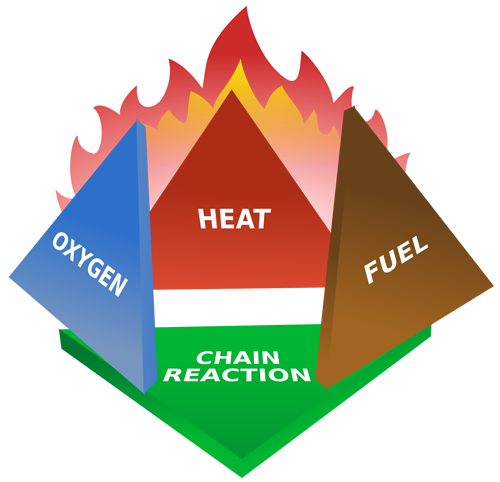 B - Fast burning C - Flashing-explosion burning D - Burning without flames (self-burning)
A - Slow Burning : The burning type that occurs when the combustible material cannot create gas or combustible vapor because of its structure, when there is not enough O2 and heat. Similar to the oxidation of iron (Fe) and copper (Cu) etc. metals as the result of the oxygen in the air and the temperature, the burning vapor or gas is not released, but iron oxide (FeO) and copper oxide (CuO) is created. The cellular respiration of the living creatures is also a kind of slow burning. There is no flame, light or a specific heat observed. B - Fast Burning : Examined in two groups 1) Burning with flames : : It happens when all the indicators of burning are created. The indications of burning are flame, heat, light and glow. Some materials (paraffin and wax) burn by transitioning to liquid state from the solid state, then to vapor or gas state. Some create vapors that can directly burn. Such as naphthalene. Some materials emit gases that can directly burn. Such as wood, coal... 2) Glowing: Some materials emit combustible gases as they are not vaporized. The burning of such materials is without flames, but as glowing. (coke and wood coal and cigarette) The light and heat are clearly visible and felt like the flaming process. C - Flashing-explosion burning: Flashing : Observed on materials that can catch fire easily. For Example: gasoline, LPG and natural gas. Explosion : It happens when whole material extensively expands suddenly under an effect such as heat or impact, and creates various gases and forces its surrounding and burns as explosions. For Example: Acetylene gas The explosion happens with increasing burning speed. D - Burning without flames : Burning without flame is an exothermic reaction wave that feeds itself and procures the required heat from the oxidation of the fuel. For the burning without flame to occur, it must be heated by a heat source at low temperature. Full fuel oxidation does not occur, heat and burning speed is low. The volatile material that emerges when the temperature is high, burns with flames with the oxygen. For Example: Fertilizers, leaves and fresh plants (herbs), etc. BURNING TYPES There are poisonous gases in the smoke's compound.
FIRE It happens when the OXYGEN-COMBUSTIBLE MATERIAL-HEAT which are always in the environment together are combined BEYOND CONTROL, and LIGHT (FLAME)-STRONG HEAT emerge and spread to the environment, and when it grows to a capacity that can harm the life and environment.
These are observed during a fire:
• SMELL at first stage • SMOKE at the second stage, and • FLAME at the third stage.
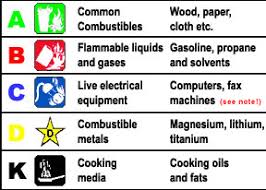
For an object to get burnt, there must be at least 14% - 16% OXYGEN in that environment. (The percentage of the OXYGEN in the air is 21% under normal conditions.) FIRE TYPES and CLASSIFICATIONS Fires are categorized in various groups based on the combustible material types. Four main groups are determined as below for this classification. A CLASS: Fires from solid combustible materials B CLASS: Fires from liquid combustible materials C CLASS: Fires from the combustible materials in gas state D CLASS: Fires from the combustible light metals
A CLASS FIRE : VARIOUS WOOD, COAL, PAPER, PLANT, RUBBER, TEXTILE MATERIALS, SUGAR, LEATHER, ETC.. B CLASS FIRE : GAS OIL, BENZINE, MACHINE OILS, DIESEL OIL, ALCOHOL, VARNISH, OIL PAINTS, ETC.. C CLASS FIRE : METHANE, PROPANE, BUTANE, LPG, ACETYLENE, NATURAL GAS, HYDROGEN, ETC.. D CLASS FIRE : ALUMINUM, MAGNESIUM, SODIUM, POTASSIUM, LITHIUM AND THEIR ALLOYS AND MIXTURES, ETC. REASONS OF FIRE A — Not taking the fire protection precautions, B — Lack of knowledge, C — Negligence and lack of attention, D — Accidents, E — Splashing, F — Sabotage, G — Natural events. A - Not taking the fire protection precautions : The most important reason. Fire is caused by not protecting the electric contact, heating systems, LPG tubes, explosive-combustible materials enough. Fire disaster can be reduced to a great extent when electric energy parts are in compliance with the technical conditions, when LPG tubes are correctly used, when chimneys are cleaned and required precautions are taken for explosive-combustible materials. B — Lack of Knowledge : The method of fire precautions must be known. Not knowing how to correctly use the electrical equipments, placing the heating systems at wrong locations, placing easily-combustible materials at the attic are invitations for the fire. Let us learn about the fire to prevent its occurrence and to extinguish it. C — Negligence and lack of attention : It is not enough to be informed on fire. Big fires can occur because of a match or cigarette end that is thrown while it is still burning, because of the LPG tube or tea maker that you forgot to turn off, a forgotten furnace where fire is still burning or any electrical appliance which is not unplugged. Therefore we must be careful and meticulous to prevent fire. D — Accidents : Fire can occur because of some of the involuntary actions. Being sufficiently informed about fire helps us about how to behave during such incidents. E — Splashing : It is always possible that a controlled fire can be spread as the result of negligence or lack of knowledge or can flash-explode and leap to other locations. F — Sabotage : Some people deliberately start fires because of various reasons and profit. The required precautions must be taken to prevent such things. G — Natural events : The fire may occur during windy weather when the dry branches rub against each other or because of lightning, earthquakes or similar natural events. DANGERS AT THE FIRE LOCATION
FIRE FIGHTING METHODS A - WATER The most commonly used material in fire fighting is water. Water is a material that cools, covers, flows, mixes and spreads. The water sprayed on the fire area absorbs the heat and gets vaporized and gains wider volume, as it is heavier from the oxygen in terms of density it covers the combustible material and its surrounding area and makes the oxygen go away from the environment. The extinguishing property of water is observed when it contacts with the burning material. This extinguishing property is versatile and as explained below. Cooling Property; Generally, when water contacts a burning object, the contact area is cooled below the burning temperature and the fire is extinguished. Coverage, suppression property; Expelling the air from the fire area by creating enough water vapor to extinguish fire, in other words ensuring fire does not get any oxygen. But when the water vapor with a specific temperature is dense enough, then it will have a heating function contrary to cooling function. Moreover, it must be remembered that water will cover the liquids heavier than water but this property cannot be used for liquids lighter than water. Some combustible materials emit oxygen when getting burnt and the air does not need to have oxygen, therefore the water's suffocation ability shall not be considered at all. Usability for emulsion; When there are two liquids that do not get mixed, one of them is spread on the other one and small droplets occur. Such droplets cover the top of the combustible liquid for a while, stops the burning and spreading. Water sprayed on fuel-oil stops burning when sprayed as thin droplets, this is called Emulsion. B - CARBON DIOXIDE It is commonly used as a fire extinguisher without color and odor, which does not transmit electric and which is a gas heavier than air. The carbon dioxide (C02) that is used in liquid fuel and electric fires is not combustible and does not unite with chemical materials easily. As it is in gas state, it spreads on fire easily and covers the combustible material. It is sprayed on the combustible material with its own pressure, C02 that is in gas stated under normal conditions can be turned into liquid or solid forms when cooled or pressurized. C02 that is stored in tubes with high pressure resistance are generally in liquid state in the tube. But it transforms into its gas state when it exits the tube. C02 in the tubes, which is used to extinguish fire, is in liquid state. If it is left at a hot place for a specific period and if it gets above 32 oC, the liquid in the tube will turn into gas immediately. Then, the tubes must be preserved by keeping away from extreme temperatures. In case of the fire extinguishers the carbon dioxide becomes cold as it will turn into gas state from the liquid state suddenly when sprayed into fire, or it appears as snowflakes or white cloud and covers the top of the fire as it is 1,5 times heavier than the air, and suffocates the fire by cutting the air contact. As carbon dioxide (C02) is a suffocating gas, when it reaches more than 9% in the air it can cause suffocation and reaching 20% may cause deaths. When carbon dioxide is processed during fires indoors, it creates a danger because of this property. For the fire to be extinguished in scope of indoor fires, the indoor volume shall be filled with enough carbon dioxide gas depending on the type of the combustible material. The suffocation ability of carbon dioxide expels the air from above the combustible material, and extinguishes the fire by suffocating it (leaving without oxygen). Even if it is possible to extinguish the fire in metallic containers full with liquid fuel, as the containers are extremely hot, flaming can occur again after carbon dioxide is diffused. Because the carbon dioxide suffocated the fire, but did not cool it. As the carbon dioxide is insulating, it is also efficient for fires caused by electric. Because the electric generally causes sparks and therefore the materials around catch fire. Therefore if the material catching fire can be extinguished by carbon dioxide, it is correct to use extinguishers with carbon dioxide. Otherwise the expected result may not be obtained. Consequently, in fires caused by electrical reasons, firstly the electricity shall be cut off, then intervention must be made to fire depending on the fire class. C- DRY CHEMICAL POWDERS The powders used for B and C class fires are powders with sodium bicarbonate origin. But the powders used for A, B, C class fires consist of compounds with ammonium phosphate origin. Dry chemical powders are used in liquid fuel fires and the fires of the machines that operate with electric. The origin of the dry chemical powders is generally sodium bicarbonate (Na HC03). But some other materials are added to make it easier to store, preserve and use. The most commonly used ones are stearates, tricalcium phosphate. These two materials are used to prevent the powder from becoming soil because of humidity. When the dry chemical powders are applied on fire, they are separated as the result of chemical reaction because of heat, and turn into sodium bicarbonate water and carbon dioxide, each of which is efficient on different class of fires, to extinguish the fire. The dry chemical powders are not poisonous. But they make it harder to breathe when they are available in large amounts at the location. They can hinder the sight as they cover the area like fog. Usage Areas; The dry chemical powders are generally used to extinguish the liquid fuel fires. They are also used in liquid oil fires related to electrical machines as they do not conduct the electric current. The dry chemical powders are more efficient for B and C class fires. If the burning is only on the surface, they can also be used for A class fires. But it must be remembered that, the hot materials, especially the metals must be taken from the fire location after the fires extinguished by the dry chemical powders. Because flaming may occur again. When the dry chemical powders are sprayed on sensitive electric devices and telephone centrals such devices' activities can be stopped or damaged. D - FOAM The foam is a chemical compound. When mixed with pressurized water, the mixture is mixed with air while passing from the make with pressure, and the foam is produced. It covers the burning surface and cuts the connection of material with the oxygen. It has cooling, suffocating, suppression and separation properties. Therefore it is a good extinguisher. It is used for B class fires, and A class fires that cannot be taken under control. Usage Areas ;
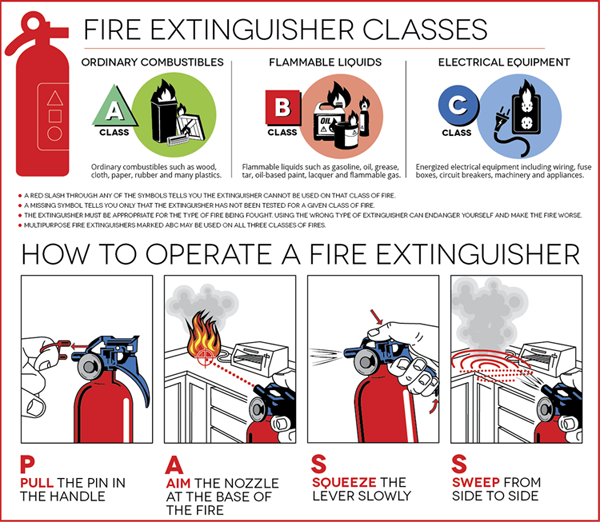
The goal is to absorbe the heat from the flame to cool it to such extent the burning reaction cannot be continued and the flame will be extinguished. It is an extinguisher that does not leave mark, spot and residue, which goes away by becoming gas. It is used to protect the sensitive devices at data processing centers, laboratories, telecommunication centers etc. It has very efficient extinguishing property that does not damage the used materials. FIRE EXTINGUISHERS They are equipments used to extinguish small-scale fires, which expel the extinguishing materials outside with the help of pressure within its body or in a separate tube. The fire extinguishers have five (5) different classes as: dry chemical powder, carbon dioxide, halogen, water and foam. PLACING THE FIRE EXTINGUISHERS
ABOUT USING THE FIRE EXTINGUISHERS
|